|
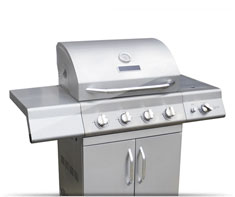
To maintain the performance, safety, and useful life of your barbeque grill, it is important that
your home maintenance program
include the proper maintenance for your barbeque grill.
Regardless of the type (propane, natural gas, charcoal) or style of your barbeque grill, proper
maintenance will help it last longer and operate more safely. See also:
Patio
Furniture and Decking.
Shown in the "Maintenance" tab above are the recommended routine
maintenance tasks for your barbeque grill. The "Questions / Answers" tab above shows
our answers to related questions. And the "Articles" tab above provides links
to related informational articles and sources.
Get tips for saving money on energy, improving
safety and more with our
free
Newsletter, or sign-up for our
free
Personalized Reminders.
|
|
|
|
|
|
|
Maintenance Task:
Clean and secure barbeque grill for the
winter (cold climates) |
|
|
|
|
|
|
|
|
|
How do you clean and secure your barbeque
grill for the winter? |
|
|
|
|
The following are the
recommended maintenance tasks which should be performed at the end of each
summer season:
-
Clean cooking grids:
Cooking grids can be made easier to clean by covering them with a layer
of aluminum foil and heating them on the grill on high for 10 to 15
minutes. The crusted on food will turn to a fine white powder that
can be easily brushed away.
-
Clean the grill: Clean the
grill inside and out with a wire brush. For very dirty situations,
you can use a paste of tri-sodium phosphate (washing soda). NOTE:
Wear gloves and eye protection, as washing soda is very corrosive.
The steps are: 1) wet down the grill; 2) apply washing soda paste; 3)
close the grill and keep it cool while it soaks in for an hour or so; 4)
rinse well; and 5) spray the surfaces with a mixture of 1 tablespoon of
white vinegar in 1 quart of water to neutralize the alkaline condition
from the washing soda. For charcoal grills, one of the best ways
to help your grill last longer is to always remove the ashes. When
ashes become wet they create lye, a caustic base, which destroys iron. It
is best to get in the habit of cleaning out ashes after each use, hosing
down the grill, then spraying it with a mixture of 2 tablespoons of
vinegar in a gallon of water, followed by letting it dry very well and
then covering or storing to keep moisture out.
-
Clean burner (gas models):
The burner is subject to great abuse from corrosive food acids, high
temperatures, and moisture. Burner life can be extended by
periodic maintenance and cleaning. To clean, use a wire brush to
remove corrosion and residue. Clean clogged gas holes with an
opened paper clip (do not use a toothpick or other object that could
break off inside). Check burner assembly for corrosion or any openings
that could allow excess air. Replace corroded or damaged burners.
-
Secure the gas supply (gas
models): For safety reasons, if you are not going to be using the grill for a while, tighten
the gas valves and consider disconnecting the gas supply and plugging
the bottle or supply line. To check that there are no gas leaks,
mix some dish soap and water, then brush it on the gas
connections. If there is a leak, it will cause bubbles to form in
the soapy water. Repair immediately as necessary.
-
Cover or move to shed or
garage: To protect the grill from the elements over the winter, either
cover it well or move to a covered area. NEVER operate a barbeque
grill in an enclosed area.
|
|
|
|
|
|
|
|
|
|
Why is it important to clean and secure your
barbeque grill for the winter?
|
|
|
|
|
Extends useful life of your
barbeque grill, and improves the safety of its operation and storage.
|
|
| |
|
|
|
| |
|
How
often should you clean and secure your barbeque grill for the winter? |
|
| |
|
Perform annually in October. |
|
|
|
|
|
|
| |
|
How
does Home-Wizard rate the costs and benefits for this task? |
|
| |
|
The
cost of this task is moderately high, from an investment of time
standpoint. It is estimated that this task
should take about 1-2 hours to complete. To complete this task, you
will need gloves, eye protection, and the cleaning products described above. |
 |
|
| |
|
|
|
|
| |
|
The
benefits of this task are that it will help extend the useful life of
your barbeque grill and improve the safety of its operation and storage. |
 |
|
| |
|
|
|
| |
|
Overall
Home-Wizard benefit-versus-cost rating (one 'hat' = low and four 'hats'
= high): |
|
|
|

|
|
 |
|
|
|
QUESTIONS & ANSWERS from
"Ask-a-Wizard":
|
|
|
|
QUESTION from Jeff Wellington on 6/17/2008
The hose from my lpg tank to the grill freezes up after it has been on for a few minutes. Someone told me the tank is too full. If it is, how do I safely reduce the level of gas? If this not the cause, what could it be?
ANSWER FROM HOME-WIZARD.COM on 6/17/2008
Dear Jeff:
When propane comes out of the tank, it converts from a liquid to a gas, and it the process it absorbs energy (which makes the surrounding materials become cold).
If you have recently filled up your propane tank, then yes, it may be possible that your tank was over-filled, and the liquid propane moving through the regulator is what is causing the freezing. And you have two options for remedying this:
1) return the tank to where you had it filled, and let them safely fix the problem for you; or
2) you can carefully let the propane burn (although it will be at a very slow rate), until the liquid level in the tank falls below the vapor outlet.
Now on the other hand, it could be possible that a small amount of water has gotten into your regulator when it was not in use, and that this needs now to be cleared out.
And yet another possibility is that your tank is not matched for the grill that you are using it for. that is, if the tank is too small for the BTU rate of the grill, then the propane would come out of the tank too fast, and therefore lead to freezing up. But if this is a standard propane tank and a standard grill, then I would not think that this would be the problem.
Hope this is helpful.
Home-Wizard.com
____________________
|
|