Air Registers: Better Air Quality & Saving Energy
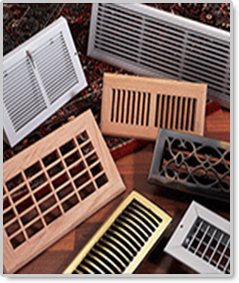
This article discusses what you can do to save energy and improve your indoor air quality from the forced air ventilation systems in your home.
Your forced air ventilation ductwork has two types of systems: 1) distribution; and 2) supply. The supply system of ductwork draws air from places around your home, and delivers it to either your furnace or your air conditioner . . . or in some homes, to both. The distribution system of your forced air ventilation ductwork takes the cooled (or warmed) air and sends it to other places around your home. When your air conditioning or heating system is running, you can put your hand over an air register and tell if it is supply or distribution duct by feeling which direction that the air is flowing.
SAVING ENERGY
To save energy with your forced air ventilation system, you should check the unfinished areas of your home (for example in your attic or basement), and see if any of your ductwork connections are leaking any air. Any air that is leaking is air that is not getting distributed properly for your home, and is wasting energy. Instead of using duct tape to seal these duct leaks, instead use duct mastic, which is more effective and permanent (see cost and review of duct mastics). And while you are reviewing your ductwork, you should also check to see if there is any loose or missing insulation, especially in your unfinished areas. Without proper insulation, you will be again wasting energy.
You will also want to be sure that none of your air registers (either supply or distribution) are being blocked by furniture, drapes, rugs, blankets, etc. Obstructing these vents prevent proper circulation of the air into or out of your room, and as a result, you have to run your air conditioning or heating system harder, which wastes energy.
On the other hand, if your forced air ventilation ductwork is ONLY used for heating or cooling, then you will want to consider seasonally blocking the registers off completely when the system is not being used, especially if your ductwork goes through unfinished areas of your home. This helps keep out hot air in the summer, and cold air in the winter. And if you want to get a really tight seal on your registers, then in addition to closing the registers, you can also cover them with magnetic covers, or by even taping cardboard or paper over the registers.
If you notice that some rooms in your home are too hot or too cold, you can "balance" the system by adjusting registers and duct dampers. An unbalance forced air ventilation system can waste energy by getting you to run your heating or air conditioning system too hard to serve the areas that are being “starved” for capacity.
And of course, you can also save energy by frequently changing (or washing, depending on the model) your system's air filters. A dirty air filter means your blower has to work harder, and therefore wastes more energy.
HEALTH
Especially if someone in your family has allergies or asthma, then you will want to properly care for your forced air ventilation system.
First, you will want to routinely clean inside of your air supply registers with a vacuum extension, and remove any objects or debris that may have fallen in floor registers. Next, you will also want to vacuum the area around where your air filters are installed. If you put your hand around where your filter gets inserted, you will likely feel air being drawn into the spaces around the filter. If your furnace or air conditioning unit is in a dusty, unfinished area of your home, then dust that builds up in the area around your filter can get drawn into your ductwork and distributed around your home. And this is why you will want to routinely vacuum the dust and dirt from these areas.
You can also improve the air quality in your home by upgrading the type of filter you use to one that is higher-efficiency, which will capture more pollutants and pollen. Filter efficiencies are measured by their MERV ratings, and you can read more about selecting the proper MERV rating filter in our article here: Guide to Choosing & Changing Your HVAC Air Filters
And finally, you can improve the air quality in your home by having your ductwork professionally cleaned to remove dust and mold.
Related Articles . . .

Energy Efficient Way to Better Indoor Air Quality
Air quality inside a home is typically 5 times worse than outdoor air quality. This article describes how Indoor Air Exchangers can give your home fresh outdoor air without losing heating or cooling energy.

Reducing Humidity in Your Home: Why & How-To
As we head towards the hot summer months, home humidity becomes a problem. This article discusses: the benefits of reducing home humidity; signs that your humidity is too high; and steps you can take to reduce humidity in your home.

Protecting Your Family From Mold
Keeping your home free of mold requires: prevention; quick action; and sometimes the help of a trained professional. Here are some suggestions for preventing and managing mold around your home.

Guide to Choosing & Changing HVAC Air Filters
For saving energy and improving air quality, changing the air filters for your furnace is important. This article discusses: why you should change your air filter; how often to do it; how to choose the right filter; and how to do-it-yourself.
