|
QUESTION from
rneilan on 3/3/2008:
I have a unico high velocity air and heat system.
The heat system is fired by oil.
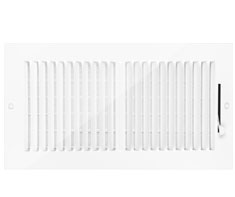
I have three return filter vents. I am aware these filters should
be changed regularly for the system to operat efficiently. However,
should these filters get real dirty over a period of six months
or so due to neglect etc..would it follow that the heating sytem
would run overtime trying to bring the building up to the set
temprature resulting in not only a higher use of electricity
but also oil. If this were to occur over the winter months in
New England can you estimate a a percentage the loss of efficiency.
For example, as a pwercentage,how much more oil would I be burning
due to the lack of efficiency. Can this be estimated? Thank
You
ANSWER FROM HOME-WIZARD.COM
ON 3/3/2008:
Dear rneilan:
A good rule of thumb is that dirty air filters can cost you
up to an additional 10% in energy costs. Its not as much the
fuel (oil) to run your furnace, but rather, its the additional
electricity to push the air across filters that have higher
resistance because they are dirty.
If you want to calculate more specifically what it could be
costing you for your particular equipment, here is a website
that describes the calculations to do this:
http://findarticles.com/p/articles/mi_pwwi/is_200510/ai_n15704065
Hope this is helpful.
Home-Wizard.com
____________________
QUESTION from
Ken on 1/31/2008:
Hi I have to replace my steam radiator air valve. The air
valve I have is shape like a long cylinder but the one I have
to replace it with is shape like a bullet. My question does
the shape make a different in the way steam will run through
my house or is it that different brand make the air valve in
different shapes?
ANSWER FROM HOME-WIZARD.COM
ON 1/31/2008:
Dear Ken:
Are you refering to your steam radiator "air" valve which is
located near the top of the radiator, or do you mean your steam
radiator "pressure reducing" valve which is typically located
near your boiler?
Home-Wizard.com
____________________
FOLLOW-UP QUESTION
from Ken on 1/31/2008:
Here's more information to my question . . . The steam radiator
"pressure reducing" valve which is located near my boiler in
the basement I think this is what I was referring to it is located
on the top of a pipe near the boiler and you can hear it let
air out from time to time . I hope I was able to explain it
better to you the part seems to go by few different name Air
Valve,steam radiator valve etc..
ANSWER FROM HOME-WIZARD
ON 1/31/2008:
Dear Ken:
Yes, you are correct, the pressure-reducing valve is also called
the “automatic make-up valve” or the “feed-water pressure regulator”.
The pressure-reducing valve connects the house plumbing supply
system to the boiler water. It is designed to automatically
maintain an adequate amount of water in the boiler at the desired
pressure (12 to 15 psi).
The pressure-reducing valve can also be part of an assembly
that includes a pressure-relief valve. Some types of pressure-reducing
valves have a check-valve inside of them that prevents water
flowing back from the heating system into the plumbing system,
and as such, it acts as a backflow preventer. Note however that
some towns require the backflow preventer to be separate.
Since it sounds like your new pressure-reducing valve is significantly
smaller than your previous one, I’m wondering if the one that
you replaced was also a pressure-relief valve or had a check-valve
inside of it. If this is the case, then your system could now
be potentially operating without either a pressure-relief valve
or a backflow preventer. This is not good, and it NEEDS TO BE
VERIFIED AS SOON AS POSSIBLE. If you no longer have a pressure-relief
valve or backflow preventer in your system, then you could potentially
over-pressure your system or have heating system water flowing
into your household drinking water.
Hope this is helpful.
Home-Wizard.com
____________________
FOLLOW-UP COMMENT from KEN on 2/4/2008:
THANK YOU FOR YOUR REPLY ON THE AIR VENT I FOUND OUT THAT THE
VENT I HAD WAS THE SAME KIND BUT IT WAS AN ADJUSTABLE AIR VENT.
BUT TO BE ON THE SAFE SIDE I REPLACE MY AIR VENT WITH THE EXACT
SAME ONE THANK YOU VERY MUCH FOR YOUR HELP
ANSWER FROM HOME-WIZARD.COM
ON 2/4/2008:
Ken:
. . . you are very welcome.
Thanks for the feedback! And we're glad we could help you.
Regards,
Home-Wizard.com
____________________
QUESTION from Bob
on 5/21/2008
I always forget which way cold air returns should be set!
Is the lower one open in winter and the top close or is it the
reverse?
ANSWER FROM HOME-WIZARD.COM
on 5/21/2008
Bob:
Its a good question.
The way to help keep it straight is to remember that warm air
rises. And then depending on the season asking "where do I want
the 'unconditioned' air to come from"?
For example, in the winter, since the air near the floor will
be cooler near the floor than it will be near the ceiling, and
your goal in the winter is to heat the air in the room up, you
will want to draw the cool air from near the floor into your
heating system so that it will be heated up.
And then alternatively, in the summer, since the air near the
ceiling will be warmer than near the floor, and your goal in
the summer is to cool the air in the room down, then you will
want to draw the warm air from near the ceiling into your air
conditioning system so that it will be cooled down.
So "summer ceiling" and "winter floor".
Hope this is helpful.
Home-Wizard.com
____________________
QUESTION from Bekkie
on 8/19/2009
yes that is correct the air flow is very light coming out of
the vents, we did install an in line fan hoping that would force
more air out seems to be helping some. We change the air filters
about every 30 to 45 days, and the airconditioner outside is
ok. I would like to be able to just not have it so cold in the
lower level and so warm upstairs.
Can you think of any thing else we can do?
Bekkie
ANSWER FROM HOME-WIZARD.COM on 8/19/2009
Bekkie:
Have you tried dong something like the following:
o open the supply vents on the lower level.
o have someone go upstairs and feel the upstairs supply vent.
o then fully close all of the vents on the lower level.
o then ask the person upstairs if when you closed the lower
level if they could feel an increase in the air flow from the
upstairs' supply vent.
If there is no (or very, very small) change in air flow when
you do this, then I'm wondering if:
1) there is a damper in your ductwork that is stuck in the closed
position (You said that you have only lived there for 2 year,
so maybe the previous owners didn't want to spend the energy/money
to cool the upstairs, so they put in a damper to keep the cooling
all down on the lower level?).
2) or there is an obstruction in the ductwork going up to your
second floor.
Just let us know what you find out. If this doesn't work, maybe
we can figure out something else which could be causing your
problem.
Regards,
Home-Wizard.com
____________________
|