Energy Efficient Way to Better Indoor Air Quality

We’ve all heard about the problems of air pollution in the environment, but most people are shocked to find out that the air quality in their own homes is actually a much greater problem. There are a number of reasons why the air quality in your home is so much worse than outside air:
-
VOC (volatile organic chemicals) being released from carpets and furniture.
-
fumes from household cleaners and paints.
-
mold from damp bathrooms and basements.
-
naturally occurring radon gas which seeps up through the foundation floors.
-
fumes from cooking and smoking.
-
pet dander.
This is where an indoor air exchanger can be so helpful. By bringing in fresh outdoor air while capturing up to 80% of the potential heat loss, these units can significantly improve your indoor air quality in an energy efficient manner. And models which are energy recovery ventilators can actually transfer the humidity between the air streams, keeping the humidity in your house when you need it in the winter, and keeping humidity out in the summertime when you don’t want it.
You can see examples of various models of indoor air exchangers online on Amazon.com: indoor air exchangers
As you will see, the prices for the units can range from about $350 to $1,400, depending on the style, capacity, features, etc. And then you will need to add the costs of the installation. Further, in addition to the initial cost of installing the unit, there are also the operating costs for electricity and routine maintenance. Electricity costs will vary according to the size of the unit you get and your local electric rates. For some models, the energy use can be as low as about 60 watts (about the same as an average light bulb), but of course, you can be saving 900 watts of heat that would have been lost through an open window.
Some models of air exchangers can be mounted in a window or wall opening, much like a room air conditioner is installed. These are designed to handle the ventilation for an individual room, such as a kitchen, living room, work studio, etc. Larger units are designed for the whole house, and provide fresh air to all the rooms of your home. These larger units are easier to install if you have central heating or air conditioning ductwork to which the units can be connected.
Your choice of air exchanger will depend on factors such as:
-
the volume of air exchange you need for your home.
-
the configuration of your home’s ductwork.
-
the humidity of the region of the country where you live.
-
how tight the construction is of your home.
HOW THEY WORK
As shown in the diagram here, the way an indoor air exchanger works is that the air ducts for the intake air are intertwined with the air duct for the outflow air in the mixing chamber. As a result, the air flows do not mix, but the heat (or cooling in the summer) from the two air flows are exchanged. As a result, fresh air from the outside can come in without losing all of the heat (or cooling) from the inside air, thereby saving up to 80% of the energy.
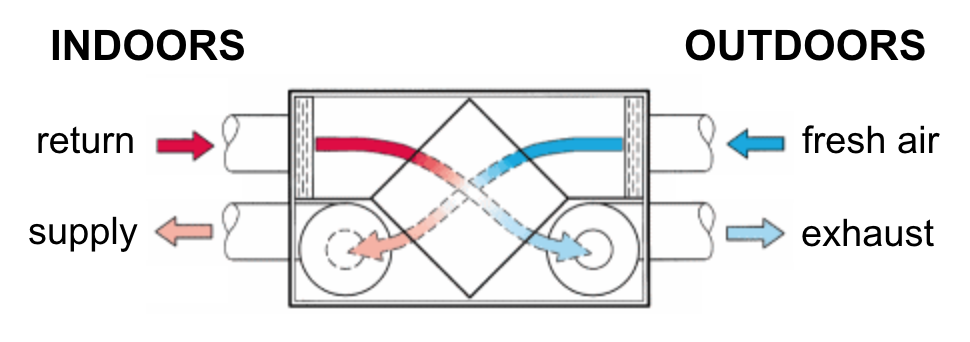
The key elements of a typical air exchanger include:
Air Ports:
From one port, fresh air is drawn from the outside, and from the other port, indoor air is ducted and expelled out.Exchanger:
The exchanger is a chamber where the separate air channels mix while separated from each other by highly conductive metal, which allows efficient heat transfer between the two air streams.Filter:
A material made of foam, metal, etc. which removes dust and dirt particles from the outside air intake.Damper:
A flat blade inside the air exchanger, which controls the amount of airflow.Ductwork:
Channels in your house where the air flows through.Drain pan:
A reservoir here water condensation is collected.Condensate pump:
If the air exchanger is located in a basement below grade, then it will need a pump to eject the water condensate.WHAT CAN TYPICALLY GO WRONG:
Most of the problems with an air exchanger can be related to humidity. If you do not have the right size or type of unit for your particular home and weather environment, you can find problems such as:
-
The air exchanger will not turn on often enough, because it is limited by the humidity of the outside air.
-
The unit is undersized for the volume of air in your home.
ROUTINE MAINTENANCE:
Routine maintenance for an air exchanger will, of course, depend on the specific model that you have. But typical maintenance tasks for an air exchanger will include washing or replacing the filters on a regular basis, cleaning the exchanger chamber, and ensuring that the vents are clear and operating properly.
SUMMARY
Indoor air exchangers are a great innovation for improving the quality of air in your home for you and your family, on an energy efficient basis. However, you will want to carefully choose which model is appropriate for your particular home situation, and if you already have one, you will want to do the proper routine maintenance for it.
Related Articles . . .

How to Allergy-Proof Your Home
If someone in your family suffers from allergies or asthma, you will want to take steps to eliminate the triggers in your home environment that make them miserable. Here are 21 tips to help you allergy-proof your home.

Reducing Humidity in Your Home: Why & How-To
As we head towards the hot summer months, home humidity becomes a problem. This article discusses: the benefits of reducing home humidity; signs that your humidity is too high; and steps you can take to reduce humidity in your home.

Protecting Your Family From Mold
Keeping your home free of mold requires: prevention; quick action; and sometimes the help of a trained professional. Here are some suggestions for preventing and managing mold around your home.

Guide to Choosing & Changing HVAC Air Filters
For saving energy and improving air quality, changing the air filters for your furnace is important. This article discusses: why you should change your air filter; how often to do it; how to choose the right filter; and how to do-it-yourself.

Air Registers: Better Air Quality & Saving Energy
If you have air registers in your home for either air conditioning or heating, then this article will help you save money on energy, and will help you ensure healthy air quality for your family.
